Potato Baby Food Recipes and Ideas
Updated: Sept 02, 2023
These potato baby food recipes and ideas will help you transform the humble white potato into delicious dishes your baby will love!
NOTE: Please consult your doctor before you introduce these potato baby food recipes, or any new foods, to your baby.
The information given here is for guidance only and does not replace professional medical advice.
Nutrition information
Everyone knows that sweet potatoes are one of the healthiest veggies around, meaning that they are often used in recipes in place of white potatoes.
But – whilst white potatoes do not match up to sweet potatoes in terms of nutritional value – they do still provide some important dietary elements.
Potatoes are a good source of vitamin C, vitamin B6 (which supports the formation of almost all the new cells in your baby’s body) and potassium.
They also contain fibre, iron, folates, riboflavin, thiamin, niacin, zinc and magnesium!
As with many other veggies and fruits, the nutritional value of potato is maximized by leaving the skin on.
Handy tip…
When peeling potatoes for your baby food recipes, remove the thinnest layer of skin possible.
Of course, potato skin may be difficult for younger babies to chew or gum (although the tender skins of new potatoes will sometimes mash up quite well!).
Plus, the large amount of fibre that potato skins provide may be a little too much for the digestive systems of younger babies to handle.
But – once your baby is coping well with a variety of foods – you may like to leave the skin on in some of your homemade potato baby food recipes (see the recipe for homemade potato fries below).
Learn more about the pros and cons of peeling fruits and vegetables for your baby
Although the skin is a good source of nutrients, a great many of them reside just under the skin, too!
CARBOHYDRATES
Potatoes are packed with carbohydrates.
Carbs tend to get a bad rap – but the carbohydrates in potatoes are complex carbs – the ‘goodies’ of the carbohydrate world!
They are the primary source of fuel, helping to feed the brain and providing power to those little muscles!
The carbohydrates in potatoes contain something called ‘resistant starch’ – so named because it resists being digested on its way to the large intestine!
Once there, it acts like fibre, in that it lowers cholesterol and helps guard against colon cancer.
It also gives a satisfying feeling of fullness, which is probably why potatoes are a popular comfort food!
Unfortunately, the health benefits of potatoes tend to be negated by the unhealthy methods used to cook them (think deep frying!) or the toppings that are added to them (think tons of melted cheese, sour cream and bacon!).
And this is a shame, because potato cooked healthily can STILL be delicious, as your little one is about to discover!
When can my baby eat potato?
Potatoes are rarely responsible for allergic reactions and this – along with their relatively neutral flavour – makes them suitable as a first food.
Remember that the American Academy of Pediatrics, World Health Organization and other medical authorities do not recommend introducing solid foods until your baby is AT LEAST 6 months of age (you can read more about introducing solids here).
Choosing and storing potatoes
Choose firm potatoes to use in your potato baby food recipes, with nice smooth skins and no cracks or wrinkles.
Green or sprouting potatoes
We recommend avoiding potatoes that are sprouting.
Some sources say they are safe to eat if you cut out the sprouts, although others suggest they may be harmful.
For potatoes destined to become baby food, we’d rather not take the risk and give sprouting potatoes a miss.
Potatoes that are green, however, seem to have greater potential for harm.
The green colour develops when the potatoes are exposed to light and is caused by higher chlorophyll levels.
But it could also be an indication that the potato is high in chaconine and solanine.
These are alkaloids which, when consumed, may lead to diarrhea, nausea and vomiting.
It’s possible that these alkaloids may also be present in sprouted potatoes.
Do remember that – even though these substances may not affect the adults in the family – they may have a greater effect on your baby.
Try choosing muddy potatoes from the store rather than ones that look as if they’ve been washed.
We notice that they keep for longer, possibly because the earth is protecting the skins from the light.
Potato storage tips to avoid sprouting/green discolouration
Handy tip…
Potatoes start turning brown once they’re cut. To avoid this, cut them just before use OR place your cut potatoes in a bowl of cold water.
Unless you buy them loose (recommended), potatoes tend to come in plastic bags.
Keeping your potatoes in plastic bags is one of the quickest ways to encourage them to rot – so empty them out as soon as you get home and transfer them to a cloth bag, preferably made from natural fibres.
Keep the bag in a cool, dark, well-ventilated place… but not the fridge!
Why?
Because the starch in the potatoes will turn to sugar, adversely affecting the flavour.
Stored properly, mature potatoes can last for up to 2 months.
What type of potato should I use in my baby food recipes?
There are many varieties of potato worldwide, with brown, yellow – or even purple – skin! (We actually posted about the purple variety here on our blog).
Potatoes are fairly interchangeable in recipes.
For the most part, you can use any type of potato in any dish – but there are definitely certain types of potato that lend themselves better to some recipes than others.
That’s because different varieties of potatoes tend to vary from a ‘waxy’ texture to a ‘floury’ one.
Waxy potatoes are somewhat moist and translucent in appearance and hold their shape during cooking.
Examples of waxy potatoes include Charlotte and Maris Peer.
Floury potatoes contain more starch than waxy ones and this gives them their drier, more granular texture.
They don’t keep their shape well during cooking, making them ideal for fluffy mashed potato!
Examples of floury potatoes include Russets, King Edwards, Maris Piper and Desiree.
What are ‘new’ potatoes?
New potatoes are simply regular potatoes harvested earlier than the rest of the crop!
At a glance…
The best potatoes for boiling and steaming:
Yukon Gold, Estima, Round White, Osprey, Charlotte, Viking
The best potatoes for roasting:
King Edward, Maris Piper, Desiree
The best potatoes for jacket potatoes (baked in their skins):
Russet, Estima, King Edward
The best potatoes for mashing:
Russet, Yukon Gold, Caribe, Saxon
The best potatoes for potato salad:
Charlotte, Round White, red skinned, Maris Peer
The best potatoes for pureeing:
Fingerling
Potato puree
We don’t actually recommend pureeing potatoes (with the exception of the delicate Fingerling potatoes, which are actually quite good pureed!).
The reason for this is that pureed potato tends to have the consistency of glue – unappetizing, to say the least.
Mashing is a far better method of preparation and gives a texture that most babies can cope with very well.
However, the relative blandness of potato means it’s not always ideal served alone – in fact, our little ones have always gagged on plain potato!
It’s best when paired up with another pureed or mashed vegetable.
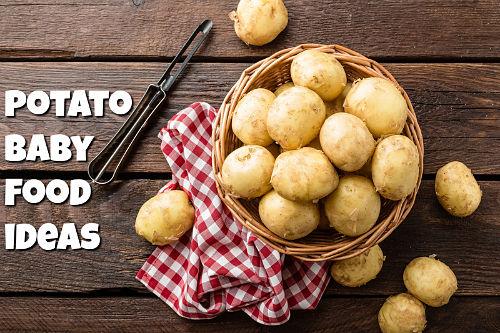
Potato baby food ideas
- Make a finger food for even the youngest self-feeders by boiling new potatoes with a little fresh mint or dill until fork tender, then cooling and cutting into dice.
- Make an eye-catching and nutritious dish by swirling cooked sweet potato and white potato together.
- Mash cooked potato with hot milk (use breast milk or formula if you prefer) and add a little roasted garlic for a simple yet tasty version of mashed potato.
- Simmer peeled, diced potatoes in low sodium or homemade chicken stock or vegetable stock, with a clove of garlic thrown in for an interesting and savoury flavour.
Serve it ‘as is’ for older babies or mash well for younger ones.
- Mash warm, cooked potato with cream cheese, cottage cheese or ricotta for an extra helping of all-important calcium.
- Fill an icing bag with pureed mash potato. Pipe out designs for your baby on to a greased baking sheet. Cook at 400 deg F (200 deg C) until golden.
- Mash potato with butternut squash, carrot or swede (rutabaga).
Pair up mashed potato with more watery purees, such as zucchini (courgette) – it will thicken them nicely.
Add a chunk of cooked potato to any puree you make for your baby that needs thickening. - Mix mashed potato with a little unsalted butter, warm milk, a tablespoon of cooked, boneless, white fish and a tablespoon of grated Cheddar cheese for a simple fish pie.
- Steam waxy potato dice, then toss with olive oil and fresh, chopped chives and parsley.
Potato baby food recipes
Simple Root Veggie Mash
1 medium potato, peeled and cubed
1 medium carrot, peeled and sliced
1 medium parsnip, peeled and sliced
low sodium or homemade chicken or vegetable stock
- Place the prepared vegetables in a small saucepan and just cover with the stock.
- Simmer until all the vegetables are fork tender (5-10 mins).
- Mash thoroughly or – if you want it completely smooth – puree in a food processor.
Super Stuffed Baked Potato
1 medium potato (Russets or King Edwards are best)
1 clove garlic
3 spring onions (scallions or green onions), chopped
fresh herbs
2 tsp olive oil
2 tsp unsalted butter
- Heat the oil and butter in a small frying pan/skillet.
- Saute the onions with the garlic until tender. Remove from the heat.
- Using an apple corer, remove the centre of the potato as you would with an apple. Save the piece of potato you remove.
- Fill the cavity in the potato with the onion/garlic mixture and fresh herbs. Use two pieces of the potato you cut from the middle to make ‘lids’ for either end of the potato.
- Push in the ‘lids’, then wrap the potato in foil.
- Bake at 400 deg F (200 deg C) for 1 to 1 1/2 hours, until tender.
- Remove the foil, then halve the potato and scoop out the flesh.
- Mash well for a delicious potato dish that’s infused with flavour!
You can also add cooked meat – or anything else your baby loves – to the ‘stuffing’ before baking.
More potato baby food recipes from our blog…
Cheesy Potato Veggie Soup
1 lb potatoes (Russets are ideal), peeled and cubed
2 oz (1/4 cup) sweet potato, peeled and cubed
1 tbsp butter
2 spring onions (scallions or green onions), sliced
1 clove garlic, chopped
1 tbsp flour
4 fl oz (1/2 cup) milk
2 oz (1/2 cup) grated cheese
- Place the cubed white and sweet potatoes in a saucepan and pour in 4 fl oz (1/2 cup) water.
- Simmer until tender.
- Using a slotted spoon, remove around half of the cooked potatoes and set aside. Pour the remaining potatoes and cooking water into a blender and puree until smooth.
- Melt the butter in a saucepan and cook the onion and garlic until tender.
- Stir in the flour, then slowly add the milk, creating a sauce.
- Stir in the pureed veggies, cooked potato dice and cheese into the sauce.
- Baby’s soup is ready!
You can experiment with the quantities used to create a thick or thin texture to suit your baby’s preferences.
Baby’s Creamy Potato Salad
2 medium potatoes (preferably Charlotte, Maris Peer or Nicola), peeled and diced
1 Hass avocado, skin and pit removed
1 tbsp natural yogurt
- Steam or boil the potato dice until tender.
- Mash the avocado well and stir in the yogurt.
- Combine the avocado/yogurt mixture with the potato whilst the potato dice are still warm (this helps them absorb the mixture and gives a creamier result).
- Serve warm or chilled.
Our little ones love this mixed with a little canned tuna!
Readers' Pics
Baby’s Creamy Potato Salad
My little one cried and created a mess at first as usual when he saw the spoon to feed him in my hand.
Once he tasted a spoon of this tasty potato recipe,he was happy… no shouting, no mess… nothing!
Thank you for the wonderful, nutritious and easy recipe..
Jayashree – Mumbai, India
Cheesy Potato Bake
3 medium potatoes, peeled
4 fl oz (1/2 cup) milk
4 fl oz (1/2 cup) half and half (thin cream)
1 garlic clove, crushed
1 sprig thyme
pinch nutmeg
2 tbsp Parmesan, grated
2 oz (1/4 cup) Swiss cheese
- Preheat the oven to 375 deg F (190 deg C).
- Slice the potatoes to a thickness of around 1/3 inch.
- Pour the milk and cream into a saucepan and bring to the boil.
- Add the potatoes, garlic and seasonings. Simmer until the potatoes are fork tender.
- Using a slotted spoon, remove the potatoes and spread out half of them on the bottom of a small, oven proof dish.
- Sprinkle with half the Parmesan and half the Swiss cheese.
- Spread the rest of the potatoes on top of the first layer and sprinkle with the rest of the cheese.
- Pour the milk/cream mixture (in which you originally cooked the potatoes) all over the potatoes in the baking dish.
- Bake for 15-20 mins, until the mixture is bubbly.
- Chop up or mash well.
Easy Peasy Potato Fries
1 medium potato
olive oil spray
- Preheat the oven to 425 deg F (220 deg C).
- Cut the potato into fries (leave the skin on for extra vitamins!).
- Rinse the fries under running water, then dry thoroughly.
- Spread the fries out on a baking tray and spray with olive oil.
- Bake until lightly golden, turning once during the cooking time.
Handy tip…
Have you ever accidentally added too much salt to a soup, stew or casserole for the grown ups?
Just toss in a peeled potato and cook the dish for another 30 minutes.
Remove the potato and throw it away – it will have absorbed a lot of the salt and your dish should be palatable again!
Potato Pancakes
These are ideal for self-feeders who are chewing well.
12 oz (1 1/2 cups) potato, peeled
2 tbsp finely chopped onion
pinch freshly ground black pepper
1 tbsp butter
- Grate the potato using a medium sized grater.
- Add the onion and black pepper to the grated potato.
- Melt the butter in a small frying pan/skillet and ensure the sides and bottom of the pan are coated.
- Tip the potato mixture into the pan and spread evenly, flattening with a spatula.
- Cover the pan and cook over a low heat for 15 mins, until the underside is golden.
- Remove from the heat and – using a wide spatula or 2 smaller ones – turn the pancake over.
- Return the pan to the heat but do not cover.
- Cook for a further 15 mins, until the bottom is golden.
You can add fresh, chopped herbs to this recipe if your baby enjoys them!
Bubble and Squeak
This is a traditional British recipe, designed to use up the veggie leftovers from ‘Sunday Roast’!
leftover roast potatoes
little butter
leftover veggies (cabbage, carrots, broccoli – anything will do!)
- Mash up the leftover potatoes, adding a little butter and milk if necessary. Don’t puree the mixture – it will be sticky and difficult to shape.And don’t overdo the milk – the mixture will be too thin.
- Finely chop the leftover cooked veggies and stir them into the mashed potato.
- Use your hands to form the potato/veggie mixture into shapes that your baby will find easy to manage.
Little round ‘patties’ or 1 inch fingers are ideal!
To cook the Bubble and Squeak…
EITHER
- Fry the fingers/patties in a little olive oil in a frying pan/skillet until golden, turning once.
OR
- Brush them with olive oil, place on a greased baking sheet and cook in the oven for about 20 mins at 350 deg F (180 deg C) until golden.
Cool to a safe serving temperature and give to your baby to feed himself.
Not only is this a great way to use up your leftovers, it’s also a great way to sneak some extra veggies into your baby’s dinner (we have more tips for encouraging your baby to eat veggies here!).
Potato Gnocchi
12 oz (1 1/2 cups) potato, peeled and sliced
1 oz (1/4 cup) flour
- Simmer the potatoes in water until fork tender.
- Drain the potatoes and – whilst still warm – puree them in a blender.
- Slowly stir the flour into the potato, until the mixture becomes smooth and a little sticky.
- Different types of potato need different amounts of flour to achieve this texture.
- On a floured surface, roll out the potato mixture and form it into a ‘sausage’, about 1/2 inch thick.
- Cut the ‘sausage’ into 1 inch lengths, then press each piece across the prongs of a fork and roll gently to create the distinctive ‘gnocchi’ shape.
- Bring a saucepan of water to the boil. Drop the gnocchi into the boiling water. Once the gnocchi rise to the surface (about 3-4 mins), they are done.
These are a super finger food, served with pureed veggies as a dip or sauce.
Potato Scones
8 oz (1 cup) cooked mashed potato
2 tsp butter
approx 2 oz (1/2 cup) flour
3 tbsp olive oil
- Mix the mashed potato with the butter, then stir in enough flour to form a dough. The dough should be quite pliable – not dry. Different potatoes require slightly different amounts of flour.
- On a floured surface, roll out the dough to a thickness of around 1/4 inch. Cut into desired shapes.
- Prick all over with a fork.
- Heat oil in a heavy bottomed pan and cook scones for 3 mins, until the undersides are golden.
- Turn and cook for a further 3 mins.
from our blog:
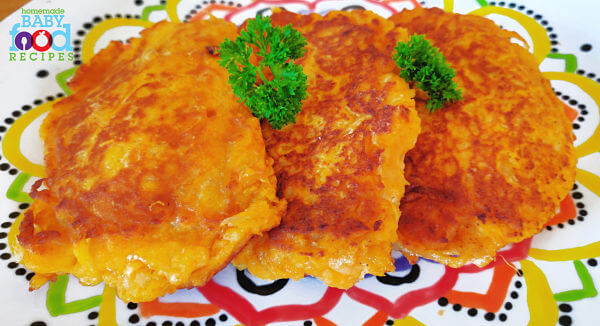
Potato pancakes for baby

Save time in the kitchen…
You can save loads of time by cooking a lot of jacket potatoes all in one go (and to speed up THEIR cooking time, push a metal skewer through them – they’ll cook up to 25% faster).
The day you cook them, serve jacket potatoes for dinner (‘flesh’ only for younger babies).
The next day, slice up one of the cooked potatoes and saute the slices in a little olive oil until golden for a tasty finger food.
On the third day, mash the potato flesh with a little unsalted butter and natural yogurt!
And don’t forget the skins…
Sprinkle with Parmesan cheese, place under the grill/broiler until the cheese has melted and serve with a natural yogurt dip to older family members.
We hope your baby enjoys these yummy potato baby food recipes containing the humble spud!
Sources:
www.netdoctor.co.uk – Carbohydrates
Discover more ideas for baby’s menu…
Sweet potato baby food recipes
Pear baby food ideas and guidelines
Lentil baby food recipes and tips