
Storing Baby Food In The Refrigerator and Freezer
This page aims to answer some of your questions about storing baby food and gives you some tips for coping with power outages.
Storing baby food safely – refrigeration
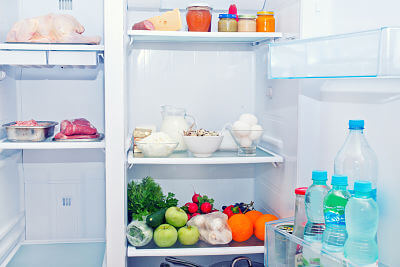
Safe storage is a vital part of baby food preparation – so it is very important to make sure that your refrigerator is running efficiently.
Follow these simple steps to make sure that the food for your baby is kept at a safe temperature…
- Your refrigerator should be kept at – or below – 40 deg F. If it’s running at a higher temperature than this, illness-causing bacteria will thrive and quickly multiply.
- To check the running temperature, use a refrigerator thermometer or an appliance thermometer. These are available at many grocery and hardware stores. An effective way of gauging an accurate temperature is to sit a glass of water on the refrigerator’s middle shelf and place the thermometer in the water. Please note that it takes anywhere between 6 to 8 hours to get an accurate reading.
- Good refrigerator maintenance is key – not just to ensuring a proper running temperature but also to conserving energy (which, of course, will save you money). There are just a few, simple steps to follow – the grill at the front of the refrigerator is necessary to keep air circulating to the condenser. Make sure that it is always free of dust. You should brush the condenser, or vacuum it, at least once every 2-3 months. And make sure the refrigerator itself is nice and clean – a dirty one will operate less effectively!
Storing baby food safely – freezing
Ideally, your freezer should operate at 0 deg F and should never run at a temperature above 5 deg F.
You can keep an eye on the temperature with a freezer thermometer. You will find that the freezer operates far more efficiently when it’s full – so if it’s getting a little empty, put in some containers almost filled with water to keep the temperature consistent.
We recommend storing baby food in the coldest part of the freezer. In upright models, this tends to be the top shelf, whereas chest freezers tend to be colder at the bottom.
Learn more about how to freeze baby food
What to do with baby food after a power outage?
It can be difficult to tell whether or not your baby’s food is still safe for him to eat if your power has been out for any length of time. Here are some tips to help you decide whether you should keep and use the food, or throw it away…
If you know that a severe storm is on its way, be prepared!
Freeze fresh items from your refrigerator if you don’t need to use them immediately.
Freeze containers of water that will help keep your refrigerator and freezer cool when the power is out – or buy lots of ice.
Stock up on ice packs or gel packs
You will be able to use these in coolers.
avoid opening the refrigerator or freezer doors whilst the power is out
A refrigerator should keep foods at a safe temperature for around four hours if the door is kept closed. To avoid constantly opening the door, keep items that you will need frequently in the cooler instead.
If you keep your freezer closed, it should maintain an adequate temperature without power for 48 hours if it is full. If it is only half full, it should hold its temperature for 24 hours.
Are you storing breastmilk?
If the power is out for an extended period of time and you are storing frozen breast milk, then ask your local Fire Department if they would be prepared to store it for you in their freezers.
We can’t guarantee they’ll oblige – but some parents have told us that they were helped in this way, so it’s worth asking!
Once power is restored...
...it’s important to determine the safety of your food.
Ideally, you will have an appliance thermometer which can tell you the temperature of the freezer at the moment the power comes on.
As long as the temperature reads 40 deg F or below, the food in your freezer will be safe.
If there is no appliance thermometer, then you need to individually examine each package of food.
If the food still contains crystals of ice, then you can allow it to refreeze – or you can cook it.
The food in your refrigerator should be safe to use if the power was out for 4 hours or less.
The FDA recommends that you throw away any perishable items that were stored above 40 deg F for more than 2 hours.
These items include meat, fish, poultry, eggs and leftovers – we would also add prepared baby food to this list.
Even if foods like these are thoroughly heated or cooked through, they still have the potential to cause illness if they were not stored at adequate temperatures.
What if I’m not sure how long the power was out?
If you decide to stay elsewhere during a storm – or if a power outage takes place during the day when you’re out and about – there is the possibility that the contents of your freezer may thaw completely and then re-freeze when power is restored.
So how can you tell?
One way is to check packages of foods like meat. If your meat thawed, it is likely that bloody liquid leaked from it, and this then refreezes around the package. Ice cream, too, often has a different appearance if it has completely defrosted.
Our favourite method to use if you are storing baby food and leaving your home for any length of time is the “penny method”.
Before setting off on your trip, sit a penny on top of an ice cube in your freezer compartment.
If the power is out long enough for the contents of your freezer to thaw, the ice cube will melt. This will cause the penny to drop to the bottom of the ice cube tray – so check the position of the penny on your return.
If everything has refrozen but the penny is at the bottom of the ice cube, then the food probably thawed to an extent where it is now unsafe to eat.
The US Food and Drug Administration provides more food safety tips, including the implications of flooding, hurricanes and power outages.
More Handy Tips...
Main food preparation and storage page
How to safely prepare baby food – avoiding food poisoning