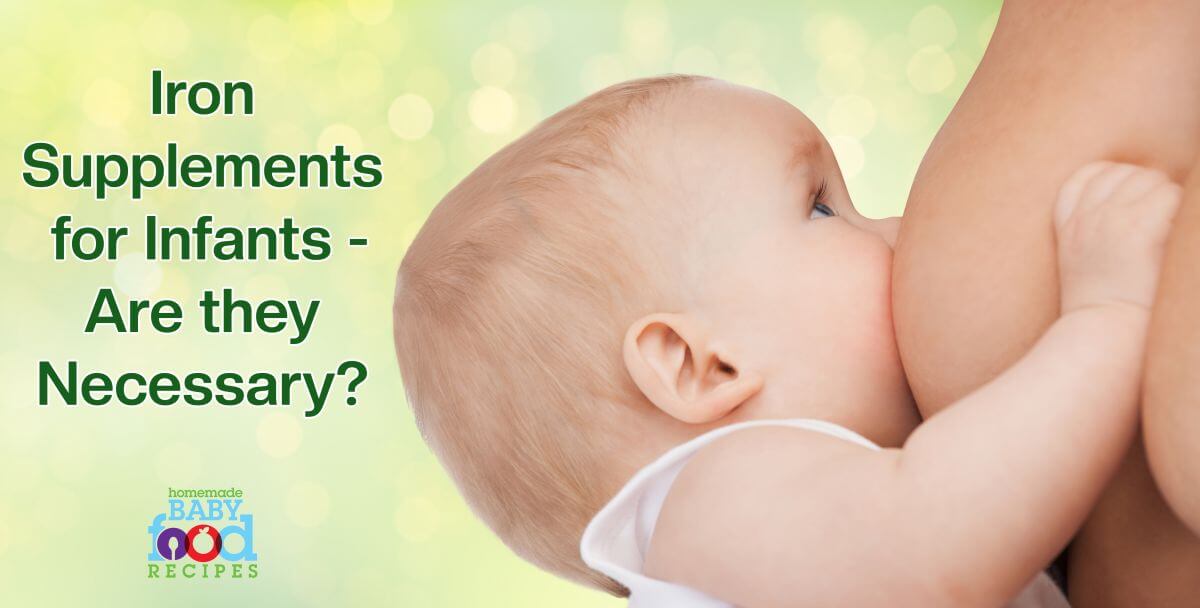
Iron Supplements For Infants – Are They Necessary?
Updated May 09, 2023
Whether or not iron supplements for infants are necessary depends on individual circumstances. But it’s important to understand the key role that iron plays in good infant nutrition and how solid feeding can affect your baby’s iron levels.

IMPORTANT: The information given here is meant as a guide and does not replace professional medical advice. Always consult a doctor when you introduce new foods to your baby or when you have any concerns about his health.
How does the body use iron?
The body needs iron to make haemoglobin, which is responsible for supplying oxygen to all the cells through the blood. It is also responsible for the colour of red blood cells – so if someone’s body lacks sufficient iron, these blood cells become small and pale, resulting in iron-deficiency anaemia.
Iron is also needed for the brain to develop and function properly – a lack of iron during infancy can have a huge impact on the ability to learn in later life.
Babies And Iron
A full term, healthy baby is usually born with enough iron stores in his body to last for at least the first 4 to 6 months of life. These stores of iron were obtained from his mother during a healthy pregnancy – the majority of iron is obtained during the final few months.
Some babies, however, are at an increased risk of iron-deficiency anaemia because they are not born with sufficient iron. These may include
- premature babies
- low birth weight babies (below 6.5lbs, even if full term)
- babies of mothers with poorly controlled diabetes
Iron supplements for infants in these categories may be recommended by the baby’s health care provider at some stage.
Breastfed Babies
In the past, some health care professionals have routinely prescribed iron supplements for infants who are breastfed. And the American Academy of Pediatrics recommends that all breastfed babies be supplemented with iron from 4 months of age.
But breastfeeding advocates question the need for iron supplements for breastfed babies, indicating that they are not necessary unless signs of anemia are present.
You can see some of the arguments for and against supplementation in this report.
Worryingly, there is also evidence that iron supplements for infants who are breastfed may be harmful, causing
- stunted growth
- decreased head circumference
- diarrhea
- reduced absorption of the vital minerals zinc and selenium
Source: Iron supplementation affects growth and morbidity of breast-fed infants
The level of iron in breastmilk is small, but is very “bioavailable”…
This is because breastmilk contains two specialised proteins – lactoferrin and transferrin. These proteins ensure that the iron from breastmilk is delivered efficiently to baby – the iron absorption rate from breastmilk is very high as a result, at around 49% of available iron.
These proteins also ensure that the iron is NOT made available to “bad” bacteria, such as E-coli and Salmonella and therefore prevent their growth.
Breastmilk also contains high levels of lactose and vitamin C, which help with the efficient absorption of iron.
The amount of iron available to baby from breastmilk reduces somewhat when solid foods or mixed feeding (breastmilk and formula) are introduced and can be greatly reduced by the addition of iron fortified foods or iron supplements for infants.
This is particularly true during the first 6 months and is another reason why your baby should be AT LEAST 6 months of age before you consider introducing solids.
The reason for this reduction in iron absorption is that the breastmilk proteins, lactoferrin and transferrin, can become saturated by the excess iron. This reduces their efficiency in delivering iron to your baby, meaning that more iron is available to harmful bacteria (leading to digestive problems) and LESS is available to baby.
Once your breastfed baby is eating foods containing iron on a regular basis, then it’s important to ensure that he is eating enough foods naturally high in iron to compensate for the reduced iron intake from breastmilk.
Learn more about introducing solids to your breastfed baby
Formula Fed Babies
The absorption of available iron from formula is much lower than from breastmilk, at less than 4%. In order to reduce cases of iron-deficiency anaemia in babies, since 1969 the American Academy of Pediatrics has made strong recommendations that all infant formula be iron-fortified and given to baby from birth to 12 months, or until he is getting enough iron in his diet.
You should not give your baby non-fortified or low-iron formula unless otherwise advised by your baby’s doctor.
Many parents are reluctant to give their child iron-fortified formula, believing that it can contribute to constipation, reflux, cramps, diarrhea, colic, gas/wind and irritability. But studies have shown that these fears are unfounded – and that the problems associated with iron deficiency are far more severe.
As with breastfed babies, it is important that the diet of a formula fed baby also contain plenty of iron rich foods.
Iron-deficiency anaemia
Iron-deficiency anemia (or anaemia) is one of the biggest nutritional problems in the world during early childhood. Some doctors routinely test babies for this between 6 to 9 months of age, as the stores of iron that baby was born with may begin to deplete at this stage.
WHAT ARE THE SIGNS OF IRON-DEFICIENCY ANAEMIA?
- Pale skin (particularly noticeable on the earlobes of babies) and paleness of mucous membranes
- Lack of attentiveness/listlessness
- Frequent illness
- Reduced appetite
If iron-deficiency anaemia is diagnosed by a doctor, then iron supplements for infants may be prescribed, although borderline anaemia can often be corrected when baby’s diet is adjusted to include more iron rich foods.
NOTE: Anemia is not always caused by iron deficiency – lead poisoning and thalassaemia can also produce anemia.
Foods Naturally High in Iron
- meat (particularly beef and lamb)
- peas
- tofu
- beans
- dark green vegetables (but please note that the iron in spinach is not well absorbed)
- avocado
- yam
- whole wheat cereal
- wheat germ
- barley
- blackstrap molasses
- broccoli
- millett
- amaranth
- quinoa
These foods also contain iron, although to a lesser degree –
Tips for Boosting Baby's Iron Intake
- Serve high iron foods along with foods containing vitamin C – this helps your baby’s body to absorb more of the available iron. A good example is spaghetti with a meat and tomato sauce.
- Cook in cast iron pans – the acid in some foods (like tomatoes) “pulls” the iron from the pan.
- Bake muffins or bread for baby using the iron rich grains listed above – try mixing the flour from these grains with wheat flour, which is fairly low in iron.
- Make meatballs for baby using a mixture of ground/minced beef and iron fortified cereal.
- Serve oatmeal with blackstrap molasses, which is not only rich in iron, but also contains B vitamins, essential for the production of red blood cells.
- Grind your baby’s meat finely – new research has shown that babies are better able to absorb the iron from very small particles of meat than they are from larger pieces.
- Cook grains and pulses with onions and garlic – recent studies have shown that onions and garlic may increase the body’s uptake of both iron and zinc from cereals.
NOTE: A nursing mother CANNOT increase the level of iron in her breastmilk by increasing her own iron intake.
Learn how and when to introduce meat to baby
Cow’s milk and iron
Cow’s milk is NOT a suitable source of nutrition during baby’s first year (see the risks of early introduction of cow’s milk for more information.)
Introducing cow’s milk into baby’s diet before 1 year of age can also lead to iron-deficiency anaemia. This is because cow’s milk can irritate the lining of the intestine, causing a loss of blood. Although the amount lost is small, it can be significant over a prolonged period of time, causing a noteable loss of iron.
(Note: The use of small amounts of cow’s milk in cooking and the introduction of yogurt and cheese are acceptable from 6 months – see introducing dairy for more information.)
Iron supplements for infants – the vegetarian baby
There are 2 kinds of iron available from food –
- Haem (or heme) iron – found in meats and fish
- Non haem (or non heme) – found in plant sources such as vegetables, legumes and cereals/grains
Haem iron is absorbed more easily by the body than non haem. Because of this, there have been claims that vegetarians are more at risk of iron-deficiency anaemia than non-vegetarians.
However, health authorities from around the world, including the World Health Organisation, American Dietetic Association and the British Medical Association are all in agreement that anaemia affects vegetarians and non-vegetarians at the same rate. This is mainly because vegetarians have a very high intake of iron and studies have shown that their haemoglobin levels are within the normal range.
If your baby is following a vegetarian diet, make sure that you serve him plenty of iron rich foods, along with foods rich in vitamin C – this converts non haem iron into a form more easily used by the body.
There is no evidence to suggest that iron supplements for infants are routinely required to support a vegetarian diet.
Sources/external links for further information
A prospective study of iron status in exclusively breastfed term infants up to 6 months of age (PDF)
More articles and recipes…
Vitamin C – preserving this essential nutrient in baby’s food