Lentil Baby Food Recipes Tips and Ideas
Updated: Oct 02, 2023
In some parts of the world, lentils are an important part of the diet and are eaten daily, both by infants and adults.
In other cultures, however, lentils are less popular as a food for babies and many parents worry about the potential “gassiness” or “wind” that giving their babies lentils may cause.
Yet these little legumes are very nutritious and would make a wonderful addition to your baby’s menu.
So let’s look at lentil baby food in a little more detail!
The history of lentils
Lentils, which are related to peas, have been providing nutrition to the human race for a very long time!
In fact, there is evidence of their cultivation dating back as far as 6,000 BC!
They are believed to have their origins in south west Asia and northern Syria.
Lentil seeds are contained in pods which are usually left to dry on the plant prior to harvesting.
Although there are only two main groups of lentils – large seeded and small/medium seeded – there are lots of varieties within each group.
Lentils for baby
Lentils readily take on the flavour of foods they are cooked with, making them ideal as a food for your baby.
Another point in their favour is that they are rarely responsible for any type of allergic reaction.
And, of course, with their high protein content, lentils make an ideal meat substitute for vegetarian babies.
(Please note – lentils and other legumes may not be suitable for babies with G6PD Deficiency – please see this page for more information).
When cooking lentils for baby, we recommend the red variety!
They do not cause gas as often as brown or green lentils because they contain less fibre (approximately 11% as opposed to 31%).
They also cook to a mushier consistency, so they may appeal more to your baby than the firmer varieties.
On the other hand, older babies may enjoy well cooked Puy lentils as a finger food – although it is important to make sure your baby is developmentally ready to eat lentils in this way.
Here are some ideas for preparing lentils for babies
- Keep it simple and simmer them in a good, homemade broth (see our chicken stock and beef stock recipes).
- Mash cooked lentils with your baby’s favourite veggie puree – try carrot or squash.
- Use cooked, mashed lentils as a thickener for over-runny purees.
- Throw some lentils into your baby’s favourite soup or casserole, at least 20 mins before the end of the cooking time.
Nutritional value of lentils for baby
Lentils are VERY good for your baby (and for you, too).
Here’s why they are credited with being one of the world’s healthiest foods:
Lentils are a good source of
Encouraging a taste for lentils at an early stage is a good idea, because the regular consumption of lentils in later life offers many benefits.
Because they provide slow-burning complex carbohydrates and replenish iron stores, lentils increase energy levels.
Lentils also help lower cholesterol, which means they are good for the heart.

Types of lentils
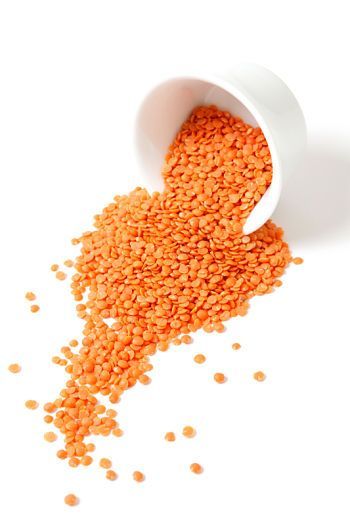
Red lentils
With their delicately sweet flavour, red lentils cook relatively quickly and tend to turn mushy.
Most commonly used for making soups and stews, they are also ideal for baby food – more about that later!
Brown lentils (also known as Egyptian or Continental)
These are the most commonly found… and also the cheapest.
They don’t have the subtle sweetness of red lentils, nor do they go as mushy when cooked.
Unless you overcook them, you’ll find that they keep their shape pretty well.
Green lentils (also known as Puy or French lentils)
These are the “creme de la creme” of the lentil world!
They were originally grown in an area of France called Puy (hence the name) but are now grown in North America and Italy.
Green lentils have a rich taste and hold together very well during cooking, so they are often used in salads.
You may also come across other colours, including black lentils (often called Beluga lentils because they look like caviar when they’re cooked) and white lentils (which are basically skinned, split black lentils).
How to cook lentils for baby
Unlike other legumes, lentils don’t need soaking – although you can soak them for a few hours if you prefer, which cuts the cooking time by approximately half.
If you don’t soak them, you should rinse them in cold water before cooking and go through them to remove any small stones.
Lentils are very easy to cook and preparation guidelines are normally included on the packaging.
They are usually simmered, covered, in 3 parts water or stock to one part lentils.
The cooking time depends on the variety, but as a rough guide…
- red lentils cook the quickest, in around 15 mins
- Then come green lentils, which take around 20 mins.
- The slowest to cook are brown lentils, which cook in around 35 mins (although it’s possible to add a little oil to the water and cook them in 20 mins if you like a firmer texture).
Cooked lentils freeze well, particularly the mushy variety!
If you want to freeze brown or green lentils and retain their texture, you should only partially cook them before freezing.
Learn more about how to freeze baby food
Dried lentils, stored in a cool place, will keep for around a year.
Will eating lentils give my baby gas (wind)?
Lentils and other legumes have a reputation for causing gas because they contain large sugar molecules that the body is unable to break down.
These molecules end up in the large intestine, where they are eaten by bacteria – and gas is produced as a result.
But not everyone has a problem with legumes – indeed, different foods tend to cause gas for different people.
The best advice is to start by giving your baby small quantities of lentils, once he is already enjoying fruits and veggies (probably at around 7/8 months+, although some babies enjoy them far sooner).
As long as there are no symptoms of digestive upset, then try offering a little more.
Consider this – babies in Indian cultures, where the lentil dish dhal (or dal) is a staple food, are regularly fed lentils from the time they start solids.
This is often at 4 or 5 months – earlier than recommended in western cultures – yet they tend to do very well with them.
Some experts believe that eating lentils and other legumes on a regular basis “conditions” the body so it is able to digest them more easily.
There are other ways in which lentils can be made easier to digest…
- After soaking, you can then try simmering the lentils for 10 mins, then draining them again.
Replace the water and continue to simmer the lentils until cooked.
Although this seems a bit tedious, many people swear by this method of improving the digestibility of lentils.
JUST BE SURE TO THROW AWAY THE SOAKING WATER – don’t cook the lentils in it! - Another idea is to try cooking the lentils very, very slowly – 1 to 2 hours for red lentils and 2 to 4 hours for brown or green.
This does seem to help and explains why lentils are more easily digested when cooked as part of a soup, casserole or stew. - Try adding a good slice of fresh ginger to the water when you cook the lentils. Ginger is a great aid to digestion.
- Avoid canned lentils for baby.
Nutritionally, they are equal to dried (as long as no extra salt or sugar has been added).
But none of the techniques above will have been applied through the cooking process – so they will be more likely to give your baby gas.
Lentil baby food recipes
Easy veggie and lentil baby food puree
1 tbsp red lentils
2oz (1/4 cup) sweet potato, peeled and diced
2oz (1/4 cup) chopped cauliflower
1 medium carrot, peeled and diced
roughly 6 fl oz (3/4 cup) milk – (use breast milk or formula if you prefer)
- Rinse the lentils, then put all the ingredients into a small saucepan. Bring to the boil.
- Next, lower the heat and simmer the mixture until the lentils are cooked and the veggies are tender (about 20-30 mins). You can always add a little more milk if the mixture begins to dry out.
- Put the mixture into a food processor and blend until smooth!
This dish freezes well – but remember, you should NOT freeze any dishes containing previously frozen breast milk.
Easy peasy lentil baby food puree with butternut squash
12oz (1 1/2 cups) butternut squash, with peel and seeds removed, then cubed
6oz (3/4 cup) potato, peeled and cubed
2oz (1/4 cup) red lentils
little pinch of ground coriander
roughly 10 fl oz (1 1/4 cups) milk – (use breast milk or formula if you prefer)
- Rinse the lentils, then place all the ingredients into a small saucepan and bring to the boil.
- Reduce the heat and simmer until the lentils are done and the squash is nice and tender (around 20 mins).
- Blend the ingredients together in a food processor until smooth.
Lentil baby food puree with fruits and veggies
2oz (1/4 cup) red lentils
1 leek, sliced
1 small sweet potato, peeled and diced
4oz (1/2 cup) cauliflower florets
8 fl oz (1 cup) chicken stock
1 small apple, peeled, cored and chopped
- Saute the leek for a few minutes in a little oil.
- Pour in 6 fl oz (3/4 cup) of stock, then add the lentils and bring to the boil.
- Reduce the heat and simmer for 5 mins, then add the sweet potato.
- Simmer for a further 5 mins, then add the cauliflower and apple.
- Simmer for a further 10-15 mins, until all the veggies are tender. If the mixture dries out, add more stock as required.
- Puree in a blender if necessary.
Dhal recipe for baby
Dhal is eaten daily in many Indian households.
You can add or omit ingredients from the following recipe as your baby prefers – dhal is a very versatile food!
You can serve it alone, with rice (brown is more nutritious) or, for older babies, with an Indian bread like nan or roti.
4 oz (1/2 cup) red lentils
little oil
1 small onion, chopped
1 tsp grated fresh ginger
1 clove of garlic, crushed
around 16 fl oz (2 cups) water
1 small sweet potato
1/2 tsp coriander
1/2 tsp turmeric
1/2 tsp cinnamon
- Heat the oil in a medium saucepan and saute the onion for a few minutes.
- Add the garlic and the ginger and continue to saute for several minutes.
- Add the remaining spices and cook for 5 more minutes.
- Add 10 fl oz (1 1/4 cups) water and stir, then add the sweet potato and lentils.
- Bring to the boil, then lower the heat and simmer for 20-30 mins, until the lentils are cooked.
If your dhal looks too dry at any point, add more water.
lentil soup with apricots
This sweet and savoury soup makes a tasty treat for the entire family!
little olive oil
8oz (1 cup) red lentils
1 small onion, diced
1 carrot, peeled and diced
1 tsp ground cumin
26 fl oz (3 1/4 cup) water
4oz (1/2 cup) dried apricots, chopped
- Heat the oil and saute the onions and carrots for around 10 mins, until tender.
- Add the cumin and stir thoroughly, then reduce the heat to very low.Cover the vegetables and leave to “sweat” for 8-10 mins.
- Add the lentils and enough water to cover the mixture. Bring to a boil, then reduce the heat and simmer gently for 20-25 mins, until the lentils are cooked and the carrots are tender (you may need to add more water during the cooking time).
- Remove from the heat and allow to cool slightly.
- Pour the mixture into a food processor and add the apricots, along with the remaining water.
- Puree until smooth.
vegetarian lentil bake
This is a nice, versatile recipe, in which you could substitute the veggies listed in the ingredients for others that your baby may prefer.
We like this combination as the resulting dish is deliciously sweet and savoury!
This meal is suitable for babies enjoying textured foods and makes a great side dish for the whole family’s meal.
4 oz (1/2 cup) red lentils
1 clove of garlic, crushed
2 carrots, peeled then grated
1 small apple, peeled then grated
2 tsp vegetable oil
16 fl oz (2 cups) water
1 tsp fresh parsley, chopped
1 tsp fresh thyme, chopped
2 oz Cheddar (1/2 cup) grated cheese
- Pre heat the oven to 390 deg F, 200 deg C.
- In a medium pan, saute the garlic and carrots in the oil until tender.
- Stir in the lentils then cook for a few minutes.
- Stir in 4 oz (1/2 cup) of the water (stand back – the mixture will probably hiss and spit)!
- Lower the heat, then gently simmer. When most of the water has evaporated, add another 4oz (1/2 cup) of water.
- Stir, then simmer for 10 mins.
- Add another 4 oz (1/2 cup) of water and continue to cook until the lentils are mushy. If you have used up all the water and they are still not done, then just add a little more.
- As soon as the lentils are done, add the grated apple, half of the cheese and the herbs, stirring well.
- Place the mixture into a small oven proof dish, then sprinkle the rest of the cheese on top.
- Finally, top with the wheat germ and bake for around 30 mins.
- The dish is ready when the cheese is golden.
Your baby will particularly enjoy this topped with homemade applesauce!
Source:
More lovely legumes: