Baby Constipation – How You Can Help Your Little One
Baby constipation can be distressing, but there are simple steps you can take at home to relieve baby’s discomfort and prevent its return.
IMPORTANT NOTE: Constipation in baby should always be checked out by a medical professional,to rule out any underlying cause.
Constipation And Solid Foods
When babies begin solid foods, their stools soon begin to look and smell quite different!
This is especially noticeable in breastfed babies, whose stools were previously smooth and almost “sweet” smelling!

Once your baby is enjoying solids, his stools will often be the colour of the food he ate.
They may also contain small pieces of undigested food.
The frequency with which he passes stools may change too – sometimes a baby can go a few days without a bowel movement.
This does not necessarily mean he is constipated – if the stool is soft when it finally appears, then it is very likely that all is well.
Straining and grunting don't necessarily indicate constipation either – these are actually quite common reactions, as your baby’s body adjusts to the new texture and firmness of his stools.
But baby constipation can arise as his intestines learn to cope with this new form of nutrition.
As a result, the stools can become hard and may even tear the delicate skin around the anus.
These tiny but painful tears can cause your baby to sub-consciously hold back his stools.
Unfortunately, this makes the problem worse.
His body will absorb the water from these stools, making them even harder, plus the large amount of stools in the intestine will cause discomfort and pain.
BABY CONSTIPATION – THE SIGNS TO LOOK FOR
- Stools are hard and dry. This is probably the clearest indication of constipation in baby.
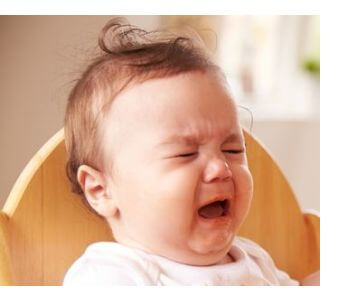
- Your baby cries as he “poos” – straining might be normal, but crying indicates a greater discomfort that needs investigating.
- Your baby seems unwilling to feed and is generally unhappy.
- Blood is visible in, or on, the stools.
REMEMBER – If your baby is displaying any of these symptoms, discuss them with your doctor.
Causes Of Baby Constipation
CONSTIPATING FOODS
Certain foods are more likely than others to trigger constipation. These include:
- rice cereal (see our article – Is Baby Rice the Best First Food For Baby?)
- unripe bananas
- cooked carrots
- applesauce
- cheese
- yogurt
- white bread
- pasta
- large amounts of potato
Other causes can include:
- underlying illness
- food allergies
- dehydration, particularly in warm weather
- certain types of medication that your baby may have been prescribed
- switching from first stage formula to a “follow-on” formula
Home Remedies For Baby Constipation
ALWAYS OBTAIN THE CONSENT OF YOUR CHILD’S DOCTOR BEFORE INTRODUCING NEW FOODS, JUICES OR WATER TO YOUR BABY.
- If your baby is eating rice cereal, try switching to an oat, barley or mixed grain cereal (note: these may not be suitable if your baby is under 6 months of age). Alternatively, learn more about introducing easily digestible avocado or sweet potato as suitable alternative first foods.
- Mix the cereal with a little prune puree, or give him the puree diluted with cooled, boiled water.
Try 1 oz of puree in 4 oz of water initially – if this doesn’t help, try diluting the puree with 2 oz of water.
Offer this diluted puree every morning and evening, until the stools soften. - Add pureed fruits or vegetables to his cereal.
- Add a little ground flax to your baby’s meals from around 7 months of age (please see this page for more information about flax seeds)
- Offer other foods that help soften stools – these include pears (a gentle but effective option that we recommend trying first), peaches, apricots, plums, cherries and peas.
- If baby is bottle fed, offer him cooled, boiled water to prevent dehydration, particularly in warm conditions.
- If baby is breastfed, increase the frequency of feeds.
- Massage baby’s tummy gently, in a clockwise direction, starting at his navel and moving outwards.
- Give him a warm bath – this will make him feel relaxed (if he enjoys his baths!) and you can continue the massage technique to “get things moving” and relieve discomfort.
- ‘Cycle’ baby’s legs – this exerts gentle pressure on his intestines by moving the muscles in his tummy.
Simply put him on his back, hold his legs and turn them gently, but quickly, in a cycling motion. - If hard stools have caused tears to baby’s anus, alert his doctor and use Vaseline to protect his delicate skin.
From our blog…
Sources and for more information:
More Useful Articles...
Allergies and digestive problems