When Can My Baby Eat Eggs? Egg Allergy Information
Updated Nov 13th, 2023
Egg allergies can be severe and are most common in infants under 12 months of age.
This page helps you decide when to include egg in your baby’s diet.
NOTE: The information presented here is meant as a guide and does not replace professional medical advice.
Always consult your child’s doctor if you suspect any allergic reaction in your baby and before introducing any new foods.

What is an egg allergy?
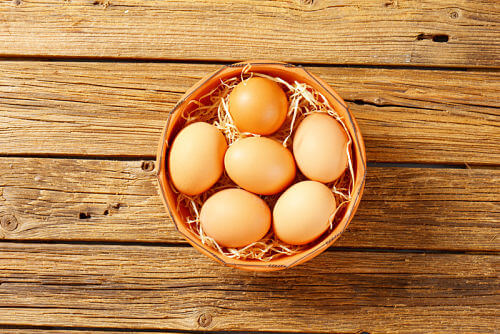
Egg allergy in baby occurs when his body mistakenly treats the protein in egg as a harmful substance (see our main allergies page for general allergy information, including risk factors and prevention tips).
Eggs are one of the most common causes of food allergy and those with an allergy to eggs tend to react to the proteins in the egg white – ovalbumin and ovomucoid.
Some children, however, are allergic to the yolk protein, although this is far less common.
Many children outgrow their allergy to eggs by the age of 5.
What are the symptoms of egg allergy in baby?
Signs of an allergic reaction to eggs tend to appear within minutes, although it can take up to a few hours for symptoms to show.
Signs to look for include
- hives
- flushing
- itching/rash around mouth, sometimes spreading to the rest of the body
- facial swelling
- tummy pain
- diarrhea
- nausea
- vomiting
- runny nose
- wheezing
- difficulty breathing
- rapid heartbeat
- low blood pressure
Occasionally, an egg allergy in baby can lead to allergic shock, a serious condition requiring immediate medical attention.
Egg allergy can only be diagnosed by your baby’s doctor or allergist.
So when can I give my baby eggs?
Because of the fact that many children tend to be allergic to egg whites, doctors have traditionally advised that parents avoid offering egg whites altogether for the first year.
If there is a family history of food allergy, then the traditional advice has been to exclude egg whites from your baby’s diet for the first 2 years.
However, the American Academy of Pediatrics published a report in 2008 stating that – in most cases – there may be NO benefit in delaying the introduction of eggs (including the whites) beyond 6 months of age (unless there is a family history of food allergy).
The report concluded that
“Although solid foods should not be introduced before 4 to 6 months of age, there is no current convincing evidence that delaying their introduction beyond this period has a significant protective effect on the development of atopic disease regardless of whether infants are fed cow milk protein formula or human milk.
This includes delaying the introduction of foods that are considered to be highly allergic, such as fish, eggs, and foods containing peanut protein.”
Although the advice is now that you may offer WHOLE eggs to your baby from 6 months of age, we strongly recommend discussing their introduction with your doctor.
Allergic reactions to eggs can be severe and your doctor is the best person to advise you if – in your little one’s case – it may be prudent to delay their introduction.
The risk of reaction from egg yolk is not as high and well cooked egg yolk may be given to your baby from 6 months of age.
You may want to wait on egg yolk too, however, if there is a family history of allergy.
Again, it’s a good idea to check with your doctor.
The easiest way to separate the yolk from the white…
…is to hard boil the egg, then simply remove the yolk.
Alternatively, you can crack a raw egg into two, then tip the yolk back and forth between the shell halves, allowing the white to drain into a cup.
However, some traces of egg white may remain and even tiny traces can lead to a severe reaction in an allergic baby.
Remember, always discuss the introduction of eggs with your child’s doctor. And if your baby has been diagnosed with an egg allergy, then you should avoid eggs altogether.
| RELATED: Is it safe to eat runny egg yolk?
Ready to get cracking?
Learn how to cook eggs for your baby and try these homemade baby food creations!
Is it OK to give my baby egg white if it is cooked?
Egg whites are allergenic whether cooked or raw, although the allergenicity of egg yolk is reduced by cooking.
If your baby needs to avoid egg whites, however, then it is not safe to use whole eggs in baking.
Ingredients derived from eggs
If your baby is diagnosed with an egg allergy, or if you do not wish to give your baby any egg products during his first year, then you need to avoid the following ingredients –
- dried eggs
- egg white solids
- egg solids
- powdered eggs
- albumin/albumen
- conalbumin
- globulin
- livetin
- lysozyme
- ovalactohydrolyze proteins
- ovomacroglobulin
- ovoglobulin
- ovalbumin
- ovomucin
- ovomucoid
- ovo transferrin
- ovovitella
- ovovitellin
- silici albuminate
- Simplesse (a fat substitute)
- vitelin
These products often contain eggs, or egg derivatives –
- baked goods
- baking mixes
- fried or battered foods
- chocolate
- creamy spreads/dressings
- lecithin
- custard, ice cream, dessert mixes
- processed meats
- French toast, waffles, pancakes
- pasta
- souffle or quiche
- soups
Also, many commercial baby foods contain egg ingredients… another good reason to make food for your baby yourself!
Egg substitutes when cooking for baby
Commercial egg substitutes are often unsuitable for use when cooking for a baby with an egg allergy, as they may actually contain egg ingredients!
The following are safe substitutes for egg, but work best in recipes where only one or two eggs are required.
They also produce quite a moist result and are good for baked foods such as muffins.
- 1 1/2 tbsp oil + 1 tsp baking powder
- 1 tsp baking powder + 1 tbsp water + 1 tbsp vinegar*
- 1 tsp yeast, dissolved in 2fl oz warm water
- 1/2 large, mashed banana
- 1 tbsp flax seed substitute (simply mix 2 1/2 oz of ground flax seeds into 8 fl oz water. Bring to a boil and simmer for a few minutes. Cool, then place in a refrigerator).
*Be aware that some baking powders may contain egg ingredients.
Learn more about introducing flax…
My baby has an egg allergy – can he eat duck eggs?
Probably not.
The proteins in eggs from birds other than hens are similar to those in hens’ eggs – and may cause the same allergic reaction.
Seek advice from your child’s doctor.
If my baby is allergic to eggs, should he avoid chicken, too?
Not necessarily, although you should check with a doctor before introducing chicken.
It is very rare for a baby’s antibodies to find any similarity between the protein in chicken and eggs, but it does happen occasionally and can cause a reaction.
If your baby has an allergy to eggs, discuss his nutritional needs with a dietician…
Eggs contain protein, iron, folate, zinc and vitamin B12 – valuable nutrients which need to be incorporated into baby’s diet in other ways.
Make sure that baby’s diet includes plenty of foods from these groups –
- meat
- poultry
- fish
- legumes
- cheese
- green leafy vegetables
- grains
SPECIAL NOTE: Babies allergic to eggs can be VERY sensitive to them and can react when eggs are cooked in the same room.
They can also react if touched by someone who has been handling raw eggs, even after the hands are washed.
Discuss suitable precautions with your child’s doctor.
External link for more information
Egg allergies and the MMR vaccination
More helpful tips and topics…
Baby feeding problems – solid foods and gagging