When Can My Baby Eat Cheese?
Discover The Safest Cheeses For Baby

Updated: Nov 6, 2023
Cheese is an excellent food for babies!
It’s packed with calcium (more info here) – and it also provides protein, vitamin A, vitamin D and vitamin B12.
In fact, the vitamin B12 content of cheese makes it an important part of the diet for vegetarian babies, as this is a nutrient often derived from meat.
Cheese also provides energy and is ideal for babies who require a calorie-rich diet.
To make things easy for us parents, cheese tastes wonderful, many babies enjoy it… and it can be easily incorporated into their meals.
This page looks at the best types of cheese for babies… and discover a little-known fact about cheese that makes it an even MORE desirable part of baby’s menu!
When can my baby eat cheese?
Guidelines for the introduction of cheese vary from one part of the world to another.
In the UK, for example, cheese is typically included in the infant diet from around 6 months of age.
Guidelines in the US, however, are more conservative, with some sources suggesting waiting until 8-9 months to introduce cheese – and others go so far as to rule out dairy products altogether until at baby is at least 12 months of age.
Cheese isn’t your typical dairy product, however.
The milk protein commonly responsible for dairy allergy is largely broken down in cheese.
So people who are sensitive to dairy can often tolerate cheese quite well.
The same applies to yogurt, which is why many pediatricians will agree that it is safe to introduce both of these products prior to baby’s first birthday.
It’s certainly worth delaying the introduction of cheese if there is a family history of food allergy (particularly an allergy to dairy products), or if your baby has asthma or eczema.
This is because cheese may act as a ‘trigger food’ for these conditions.
As with all new foods, you should talk to your doctor before introducing cheese to your baby.
The little known benefit of including cheese in baby’s diet
Well, you may not be aware that cheese can actually play a part in the prevention of tooth decay!
Your baby does not even need to swallow the cheese – merely chewing it is enough to receive its benefits!
Exactly HOW cheese protects the teeth is still a point of debate, but there are several reasons why this may be so.
For one thing, chewing cheese promotes saliva production, which both neutralizes harmful acids in the mouth and washes them away.
In fact, it is believed that cheese stops the bacteria on the teeth from turning into the acids that demineralize tooth enamel.
Further, cheese contains plenty of calcium and phosphorus – so eating it replaces minerals lost from the tooth enamel, essentially strengthening the teeth.
If you’ve always enjoyed finishing a meal with a cheese board, then this is a good reason to continue to do so – and to get baby to have a nibble, too!
The safest cheeses for baby
You’ll probably remember from pregnancy that there were certain cheeses you had to avoid, because they may contain listeria (a food poisoning bacteria).
In general, it’s actually unpasteurized soft cheeses that pose this risk – cheese made with pasteurized milk (even soft cheeses) are now considered to be safe for pregnant women.
This being said, there has been no change to medical recommendations for feeding these types of cheeses to babies.
The safest option, therefore, is to offer only the following types of cheese to your little one (although it is still important to ensure that these are made with pasteurized milk).
- Cheddar
- Parmesan
- Edam
- Colby
- Colby Jack
- Swiss
- Mozzarella
- Monterey Jack
- Romano
- Babybel
- Paneer
- Provolone
- Red Leicester
- Cheshire
- Jarlsberg
- Gouda
- Lancashire
- Double Gloucester
- Grana Padano
Did You Know?
You can make your own creamy, delicious cheese using natural yogurt!
Find out how – read our Homemade Yogurt Cheese page!
The following cheeses are ‘softer’, but are still on the safe list.
- Cottage Cheese
Ricotta - Mascarpone
- Cream cheese
- Cheese spread (make sure that your cheese spread is not labelled ‘cheese flavour’, which implies that it is NOT made from real cheese)
More information about cottage cheese for babies
You may prefer to start your baby with a mild tasting cheese – that being said, our babies loved mature (sharp) cheddar.
You may be surprised by what appeals to those little taste buds!
Cheeses you may prefer to avoid for at least the first year
- Brie
- Camembert
- Chevre
- Queso Blanco
- Queso Fresco
- Danish Blue
- Stilton
- Saga
- Gorgonzola
- Roquefort
- Wensleydale
Can I give my baby processed cheese, American cheese or pre-sliced cheese?
Although these are not harmful to your baby, cheeses like these are – frankly – pretty tasteless!
In fact, they go through so much processing that they bear little resemblance to ‘real’ cheese, either in texture, taste or goodness.
Processed cheese is ‘purpose built’ to be smooth and easy to melt, with a mild taste and uniform texture.
To achieve this, several ‘real’ cheeses are melted together and blended – then ‘extras’ such as emulsifiers, flavour enhancers, colours and stabilizers are added.
Our advice?
Keep cheese like this for your burgers and treat your baby to delicious, full-flavoured, ‘real’ cheese!
How to safely store cheese
Cheese should, of course, be kept in the refrigerator.
But please note that it should be wrapped in foil or wax paper – not plastic wrap – because the fat content of cheese can cause the chemicals in plastic wrap to leach into the food.
Using cheese in your baby food recipes
Cheese can be added to your baby’s diet in a multitude of ways!
- Firmer cheeses – or large curd cottage cheese – make great finger foods. Many firm cheeses can be easily cut into fun shapes to delight your little one!
- Prepare a simple lunch of cheese on toast (grilled cheese).
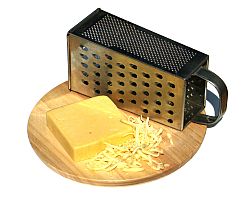
- Stir cottage cheese into cooked veggies, or sprinkle grated cheese on top (a great way to get the reluctant baby to eat them up)!
- Stir cottage cheese into cooked rice or pasta – or sprinkle firmer cheeses on top
- Add grated cheese to your omeletes, or add it to virtually any other dish – including purees and soups.
- Mix cottage cheese with fruit purees (surprisingly yummy), mash it with avocado or tofu, or use it to top oatcakes or bagel
When can my baby eat…