When Can Babies Eat Onions?
How To Cook Onions For Your Baby
Updated Oct 10, 2023
When can babies eat onions?
It’s a question we’re often asked, particularly since onion is included in some recipes on our site.
This page looks at how and when to introduce onion to baby, as well as some of the benefits of this veggie that make it a useful addition to baby’s menu.
PLEASE NOTE: The information given here is meant as a guide and does not replace professional medical advice.
It is important to discuss the introduction of any new foods with your child’s doctor.
The onion – a cooking staple the world over!
The humble onion forms the basis of recipes in just about every cuisine across the world.
Cheap and abundant, onions add flavour to every dish in which they’re used… and a surprising amount of health benefits, too.
Onions are a member of the ‘allium’ family and are related to leeks, shallots, garlic and chives.
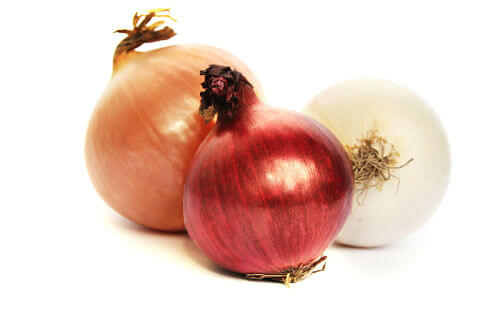
The most common onions tend to be yellow, but onions come in a range of colours – and sizes.
The general information on this page applies to all onions, including red onions and green onions (also known as spring onions or scallions) – which are actually just regular onions harvested before the bulb is fully formed.
When can babies eat onions?
Onions are – unsurprisingly – not ideal served as one of baby’s first foods, but can be introduced at some point after 6 months of age, when baby is already enjoying a range of fruits and vegetables (with your doctor’s consent, of course).
The chief concern about introducing onion to baby is NOT the risk of allergy – allergy to onions is, thankfully, relatively rare – but is mainly the affect that they may have on baby’s digestive system.
In some babies (and adults, too), onions may cause gas!
As with adults, the extent to which onions cause gas varies from child to child.
The effect is less pronounced when onions are cooked rather than raw, so we definitely recommend giving raw onions a miss until your baby is at least 1 year of age.
But a small amount of cooked onion can be mixed with foods your baby is already enjoying once he’s comfortably digesting the more typical ‘first foods’.
This tends to be at around 7 to 8 months of age.
By introducing just a little at first, you will be able to gauge if the onion has any adverse affect on your little one – if all is well, then you can begin including onion in larger quantities.
If you are concerned that your little one has a delicate tummy…
…then by all means wait until later to introduce him to onions.
But do bear in mind that onions are not necessarily a ‘no-no’ in your baby food recipes – many babies around the world enjoy them from an early age without any detrimental side effects.
More advice about introducing the typical ‘gassy’ foods on our blog
Related articles…
Introducing new foods separately – what about onions, garlic etc?
The many health benefits of onions for your baby
- Onions are an excellent source of antioxidants, those important nutrients that help protect our bodies from cancer and other serious conditions.
Research has shown shallots – and stronger onions – to have the highest antioxidant content of all! - Onions are packed with polyphenols – plant nutrients common to other members of the allium family, but most abundant in the onion.
Studies have shown that onions contain even more polyphenols than veggies like tomatoes, carrots and red peppers! - Onions have anti-inflammatory properties, so they can be helpful in reducing the symptoms of children with asthma.
- Packed with vitamin C, onions can help boost the immune system and offer protection against bacterial infection.
- Onions are good for the heart and – in later life – may help lower cholesterol.
- Eating onions can boost your baby’s iron absorption from other foods (more information about this here)
More information about the research into the benefits of onions (external link)…
Quantitative evaluation of the antioxidant properties of garlic and shallot preparations
Choosing and storing onions for your baby food recipes
So which type of onions should you use in your homemade baby food recipes?
Well, in terms of their health benefits, shallots and pungent onions are best… but we preferred to start our little ones on the sweeter tasting varieties, like Spanish onions, Vidalia or Sweet Imperial.
The sweeter varieties are usually labelled as such in the stores – they also tend to be the most expensive!
Look for onions with dry, papery skins and no mouldy spots. They should feel firm – not at all squashy.
Keep your onions in a cool, dry place at home – a hanging wire basket is ideal because it allows the air to circulate.
You don’t need to keep onions in the fridge (with the exception of green/spring onions, which won’t last long unrefrigerated).
You can also peel and chop onions and store them in the freezer.
It can be a real time-saver… but do remember that this may cause a little nutrient and flavour loss.
Preparing and cooking onions for your baby
When preparing onions for your little one, there’s one very important thing to remember –most of the ‘good stuff’ in an onion is contained in the outer layers!
Although the papery skin of an onion can be difficult to remove and it’s easier to pull of just the first couple of layers, don’t be tempted to do it!
You’ll be losing LOTS of valuable nutrients!
TEAR FREE WAYS TO PEEL AN ONION
When you cut an onion, you release gases that irritate your eyes. Here are a few steps to keep the problem to a minimum…
- Put the onion in the freezer about 30 mins before you cut it.
- Use a really sharp knife (the theory is that this minimizes damage to the onion’s cells, so less gas is released into the air).
- Leave the root on the onion until you have chopped up the rest – cutting off the root releases the most gas.
- Chop onions under an extractor fan – or aim a fan at your face.
Another common suggestion is to cut the onion under running water… BUT this can make the onion mushy AND it may wash away some of the water-soluble nutrients.
COOKING ONIONS
One of the easiest ways to cook onions for your baby is to saute them over a low heat in a little olive oil until tender and golden.
Another yummy method – which really brings out their sweetness – is to cut them into wedges and roast them at around 350 deg F for about 45 to 50 mins.
Sauted or roasted onions can really add flavour to an otherwise bland dish and we’ve never hesitated to add them to all sorts of foods for our little ones, from savoury to sweet!
Broccoli, apple and onion puree has been a big hit with all our babies, for example!
Onions also make a tasty way to add interest to grains – just try sauteing them in a low sodium or homemade stock instead of oil, then mixing with rice or barley, for example. Yum!
And, of course, onions can form the basis for your stocks themselves, as well as homemade soups and stews.
And one of the great things about preparing dishes like these with onions is that the water soluble nutrients of the onions don’t go to waste.
They leach into your cooking liquid and are then consumed by your little one!

Baby food recipes with onions
Sweet Baked Onions
This is a method for cooking delicious onions which can then be added to other dishes. Vidalia onions are perfect for this method of cooking!
1 large onion
pinch freshly ground black pepper
1 tsp unsalted butter
- Preheat the oven to 350 deg F (180 deg C).
- Peel the onion, then cut off the top and bottom.
- Cut the onion in half width-wise, then place the halves on a greased baking sheet, cut side up.
- Sprinkle them with pepper then divide the butter between the two halves.
- Cover loosely with foil and bake for around one hour, until completely tender.
- When baby is a little older, try sprinkling the onion with balsamic vinegar before baking – it brings out the sweetness even more!
Garden Pea and Onion Soup
4 oz (1/2 cup) cooked, fresh peas or frozen peas (thawed)
1 medium onion, sliced thinly
1 tsp unsalted butter
1 clove
pinch cinnamon
4 fl oz (1/2 cup) water
2 fl oz (1/4 cup) milk or soy milk (or, for a treat, cream!)
- Heat a little butter in a small saucepan and saute the onion for 2 mins. Add the clove and cinnamon and cook gently until the onion is tender. Remove the clove.
- Stir in the peas and continue to cook, stirring, for 3 to 4 mins.
- Transfer the mixture to a blender and puree until smooth.
- Return the mixture to the pot and add as much water as you desire (stirring well) to create a ‘soupy’ texture. You might prefer to keep the water to a minimum, creating more of a puree than a soup.
- Bring to the boil, then lower the heat and stir in the milk/cream. Warm through gently, then serve.
Healthy Onion Rings
A simple finger food for older babies who are biting and chewing confidently.
1 large onion
2 fl oz (1/4 cup) natural yogurt
1 oz (1/4 cup) whole wheat flour
4 oz (1/2 cup) dried whole wheat breadcrumbs
1 tsp dried oregano
1 tsp wheat germ
- Slice the onion into rings.
- Put the flour into a food safe bag and add the rings.
- Hold the top of the bag tightly and shake well, until the rings are coated in the flour.
- Place the bag of rings in the freezer and leave for 20 mins.
- Grease a baking sheet and stir the wheat germ and oregano into the breadcrumbs..
- Remove the onions rings from the freezer, then coat them individually in the yogurt. Next, coat each one completely with the bread crumbs.
- Place on the baking sheet and bake at 400 deg F (200 deg C) for 10 mins. Turn carefully, then cook for a further 10 mins, until the rings are golden brown.
- Cut into manageable pieces and serve.
More articles and recipes…
The goodness of garlic for baby (from our blog)
Lentil baby food – information and ideas
Recipes for your vegetarian baby